


Artist Series 2025: Peggy Flavin
Some people keep their passions in separate boxes. Peggy Flavin smashes them together.
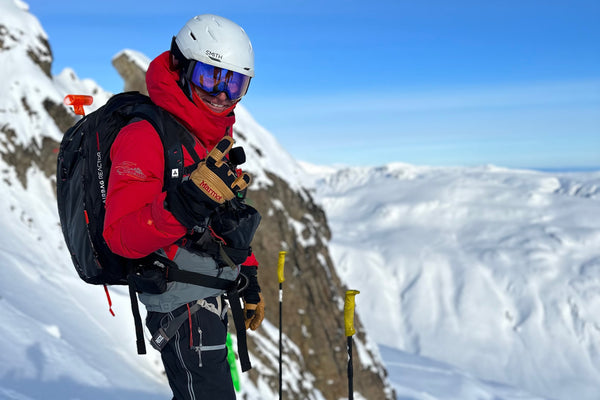
The Utah-based muralist and AFMGA-certified rock-climbing guide has built her life around two pursuits that seem fundamentally at odds—the solitary, deliberate work of painting and the dynamic, reactive flow of guiding climbers up technical routes. But ask Flavin about the distinction, and she’ll tell you they're not opposites at all.
“I climb with the same playful approach that I take to art,” she says.

This month, that intersection comes alive on Wagner's topsheets, where Flavin's animal-inspired graphics—at turns playful, vibrant, and utterly badass—capture the spirit of creatures as resilient and adaptable as she is. From “The Boss,” a legendary grizzly that survived multiple train strikes and dominated the Canadian Rockies, to “Powder Fox,” inspired by an impossible sighting on a Denali glacier, each design carries a story born from her life in the mountains.
We caught up with Flavin to talk about growing up in a huge family in Chicago, finding flow states in both art and climbing, and why she’s probably more of a “Rat Pack” person than a “Boss”—even if she won't admit it right away. Here’s what she had to say.

Wagner: How did you first get into rock climbing, especially living in Chicago?
Flavin: Rock climbing was my gateway sport to get into the mountains; I got into it when I was maybe 14 through my older brother. I have five brothers, and we’re very active and hard to keep track of, so I don’t think my parents had any idea what we were pursuing recreationally. I was pretty hooked.
Wagner: Do you still climb with your brother?
Flavin: Not really. My brother is a professor in Atlanta now, so he’s more of an academic these days. He jokes that I took his hobby and took it way too far.

Wagner: Where are you in birth order, and what was it like growing up in such a big family?
Flavin: My other brothers are younger, and I have a younger sister, too. I think my mom had a lot of work to do, but we thought it was pretty fun. Even now it’s pretty fun. I wouldn’t trade having a huge family. It explains a lot about me. I go with the flow. And guiding is known to be a male-dominated industry, but after growing up with five brothers, it’s really no problem to tell guides what to do. Altogether we were extremely energetic and creative, and because there were so many of us, I had a lot of freedom. That influences me still to this day.
Wagner: Did you discover art at a young age, as well?
Flavin: I started drawing and painting and making art when I was really young. I didn’t seriously consider that I would get to do that as my job one day, but I did go to school for art and I studied it in college. I started at the Art Institute of Chicago, which is more of a dedicated fine arts school, but went to the University of Illinois where I could also climb. I studied environmental design and painting.
Wagner: What’s environmental design all about?
Flavin: It’s a little niche, but essentially it involves topics like how to integrate design and art in a way that focuses on sustainability and conservation.

Wagner: Is there a relationship between your two passions of art and rock climbing? Does one influence the other?
Flavin: I feel both of them balance me as a person overall. I need both the active work and the art, though painting murals is still pretty active. In both of them, I'm driven by creative expression. I climb with the same playful approach that I take to art. Both are a way to have fun and see what you’re drawn to. I also have the same absorption with each. I'm equally split between the two, and I wouldn’t give up either of them.
Wagner: What’s your artistic process like?
Flavin: I have a pretty long brainstorming process and I go through a million iterations in my head before I begin. I always start with pencil and paper and a lot of scribbles, and they usually look horrible. I only share those with my sister. I usually can see where I want it to go in my head before I beigin the formal process of drawing, and once I do, I have a clear direction. Once I actually begin drawing, I’m disciplined and focused. Especially with a mural or a big painting, it ends up being a lot of logistics. I used to think it would be nice to go with the flow and leave more up to in-the-moment inspiration, but I quickly discovered you can lose control of it quickly. With a big project, I usually have a better and less stressful outcome if I have a blueprint. And even then, things end up happening you don’t expect. That’s when I improvise.

Wagner: What are some examples of things that come up that you don’t expect?
Flavin: There’s always some new thing that you didn’t anticipate. You get there and you can see that half the wall was brick that didn’t appear to be brick, and you have to adjust your whole plan. It can be a roller coaster. That’s the biggest crossover with mountain guiding is the need for general adaptability combined with a little bit of optimism. Something very unexpected may come in, and you have to be, like, OK, we’ll roll with it. It’ll play out. There’s always lots of creative problem solving in both.

Wagner: Tell me about your topsheets. Each one is so different, yet they all have an animal theme.
Flavin: To me they feel connected, but they’re also all different, too, with different energy. “The Boss” has a backstory of this legendary grizzly bear from Canada. I think he’s passed now, but he was famous. He got hit by trains several times and survived and was known for eating other bears. Of all the bears, he was in charge. I could see him being on an aggressive pair of big mountain skis.
“Powder Fox” was the first one I made, and it was inspired by my first Denali expedition. Nothing lives out there; even the birds die because they have no food. Then one day we saw a fox running around on the glacier—I felt like I imagined it, but a lot of us saw it. They’re resilient animals, and also so playful in snow.
“Snake Farm” came from my experiences climbing in Kentucky. Someone had written “snakes” in chalk to alert climbers, and we looked and there were just a pile of snakes. So I wanted to paint a dense amount of snakes to make it outrageous.
“Rat Pack” came from thinking of that rats are unusual animals that don’t get much spotlight. This one is more comedy than serious or majestic. And there’s a play on park rat.

Wagner: Which one is your favorite?
Flavin: It changes by the day. If I had to choose it would be “The Boss.” It has the most hardcore energy. But if I'm being honest, I’m more of a “Rat Pack” person. That’s probably more my vibe. Maybe I need a different pair of these for all the terrain I ski.
You can see more of Flavin’s art on her website, peggyflavin.com, or follow her on Instagram @puggyfluvin.
--
Article by Kimberly Beekman
Kimberly Beekman is the former editor-in-chief of the late, great Skiing Magazine (RIP), and a longtime editor of SKI Magazine before that. She currently uses the title of “freelancer” as a beard to ski powder all over the world. She lives in Steamboat, Colorado, with her wonderful daughter and terrible cat.
