



Yard Sale: Played by Gravity
How a long-out-of-print book by Dolores LaChapelle taught a skeptic to listen to the mountain.
Last winter, on a sunny, sparkly day in the high peaks near my house, I had the best ski turns of my life. They weren’t the deepest or the coolest, but I felt like I was part of the mountain, like it was showing me where to ski. And the inspiration to feel like that came from a place I hadn’t expected.
If you ski in Colorado’s San Juan Mountains, where I live, or maybe anywhere else across the Rockies, you might have heard of Dolores LaChapelle, the godmother of powder skiing.

The San Juans have some of the best powder snow skiing in the world
In the 1950s and ’60s, she was known as one of the best powder skiers in the world, and she helped shape early skiing at Aspen and Alta. She was also an accomplished backcountry skier, completing the first ski ascent of Mount Columbia, the second highest peak in the Canadian Rockies. She’s also known for her cult classic book, “Deep Powder Snow,” an environmental philosophy treatise that people say is the ski bum bible—an instruction manual for how to peg your life to chasing snow. It’s long out of print, but sometimes you can find it on eBay if you’re willing to shell out hundreds of dollars.
I’d heard about her—whispers about how she could predict the weather and quotes about how nothing was better than powder skiing—but I was skeptical. Her ideas about connecting to the natural world through things like rituals sounded woo woo, like some kind of mystical mental gymnastics. I measured skiing in effort and physical rush: the g-force of a turn or the steepness of a pitch. She was into tai chi and talking to the trees.
Dolores LaChapelle was regarded as the best female powder skier in the 50s
And then I got stuck in Silverton, Colo., where Dolores lived, when the passes on either side of town closed in a storm, as they sometimes do.
Someone in town keeps a stash of “Deep Powder Snow” copies for people they think might need them, and, as the storm settled in on Red Mountain Pass, I apparently became one of them. So I sat on a friend’s couch, feeding logs into the fire and reading. I read the whole thing in one sitting. Parts of it were a bit new age-y, but I mostly found it full of insight. Dolores wasn’t prescriptive or pushing weird ideas; she was trying to figure out why skiing in particular, and being in nature in general, feels so important—something I’m always trying to do.
Her best tool for figuring that out was something she called tuning: listening to the mountain, letting the snow and the hill show her when to turn, how to ski, where to point ’em, and where to glide. She said you had to feel it by letting go of the way we normally take in the world.
“Some people can never learn to ski powder snow without exerting tremendous effort and strength because they allow their rational, left-brain hemisphere to control the entire situation,” she wrote.

That part still sounded a little loopy to me. I could get behind paying attention, or noticing the snow or the weather or the slope, but listening to the mountain felt too far out. I closed the book and figured I’d just take a few ideas from it out into the world with me.
I tucked the idea of tuning in the back of my brain and skied like I always do, pressuring my edges and pushing through turns. But sometimes, when I was alone on the chairlift or slowly skinning uphill, it bubbled up to the front. Could skiing powder feel even more blissful? What signs was I not getting? Was I missing something, or was it all just hocus?
So I tried it.
I posted up on the edge of a run and waited, trying to tune in. I listened to the wind and skated my skis back and forth, trying to feel the snow. I didn’t hear anything from the mountain, but when I tipped my skis downhill and felt myself pulled into the soft snow on the edge of the trail, following the curve of the hill, picking up speed, it felt like the path of least resistance. Maybe there was something to it.
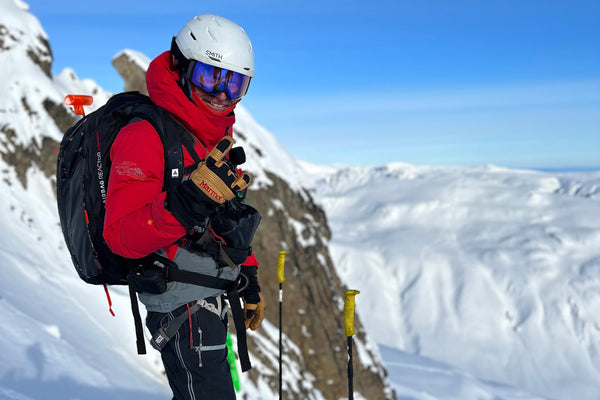
Heather learned to listen to the mountain
I kept doing it. As I tried to tune in and listen to the terrain, a Dolores quote kept coming into my head: “Powder snow skiing is not fun. It’s life, fully lived, life lived in a blaze of reality.” I listened more, taking in the texture of the snow, noticing the subtle shifts in pitch or how the snow was softer on north-facing slopes. I let that point me. I forced my turns a little less; I played a little more.
I got glimpses of tuning sometimes, when the turns felt effortless. Then, one day, it clicked. I was up on a ridge on a clear blue morning, a few days after a storm. Before I dropped in, I took my time. I stopped and watched the clouds. I ate my snack slowly. When I was ready, I stood on the edge of an open, gentle bowl and asked the mountain if it was ready, too. The snow was a carpet of glitter, the slope pulled me down, and it felt like my skis knew when to turn. Like all I had to do was pay attention.
Dolores knew that feeling. “People devote their whole lives to it for the pleasure of being so purely played by gravity and snow,” she wrote.
I’m going to keep my copy of “Deep Powder Snow” handy, for when someone visiting me gets snowed in.
--
Article by Heather Hansman
Heather Hansman is an award-winning journalist, a former editor at Powder and Skiing magazines, and the author of “Downriver,” “Powder Days,” and “Fierce Country.” A lifelong skier and a contributing editor at Outside, she lives in Durango, Colorado. 