


How to Know If You’re Skiing the Wrong Skis
How to Know If You’re Skiing the Wrong Skis (And How to Choose the Right Ones)
There’s no worse feeling than dropping serious money on new skis and, three runs in, feeling like something’s off. You may not have the right ski for you.
Choosing a ski is definitely not a one-size-fits-all approach. There are so many unique factors that you need to take into account. Factors like the terrain you ski, your ability level, skiing goals, home hill location, and your physical size and strength. If a ski doesn’t fit any one of those, you’re in for a suboptimal experience.

Image: Brett Schreckengost
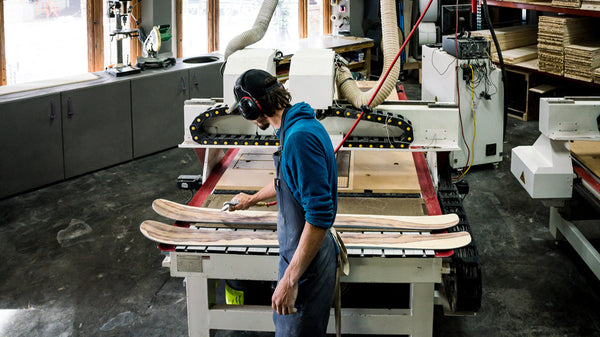
This exact scenario led to the creation of Wagner Custom: When founder Pete Wagner, a mechanical engineer and computer scientist who was designing custom golf clubs at the time, moved to Telluride in the early 2000s, he bought a pair of skis that were too demanding for him. That’s when he had his ah-ha moment.
“I realized I was creating all this technology to fit people into their perfect golf clubs, and I didn’t see anyone doing that in the ski industry,” Wagner said. “So I wrote the software for creating custom skis. It was everything I did for golfers—I collected information about each skier and the software designed all of the steps in the manufacturing process.”

Wagner designed a questionnaire that would address each skier’s individual needs, and then he used predictive engineering to determine the skis’ stiffness and performance qualities that would match those needs.
“I also built a database of other mainstream skis that cataloged materials, flex index, mounting points, and shape, so that when customers pointed to a ski they liked in the past, I could incorporate similar qualities,” he said.
So what does it feel like to have a ski that’s not right for you? Here are the common pitfalls.

Photo: Kane Scheidegger
Wrong Flex
There are two types of stiffness in a ski. The first is longitudinal stiffness (from tip to tail), which is what you see people testing when they flex the ski in a ski shop. The torsional rigidity of a ski, on the other hand, is the ski’s resistance to twisting.
A ski’s flex pattern takes into account both longitudinal and torsional stiffness, and it changes depending on skier weight and ability.
If the flex pattern is too stiff for you, it will feel unresponsive, hard to turn, and tiring. It may buck you around in bumps or pop you too hard out of a turn. It can also feel punishing, like it’s fighting you, and just not that much fun.
If a ski is too soft, on the other hand, you may feel like you’re “going over the handlebars” when you lean forward and pressure the edges. It can feel chattery or like it’s washing out on you. It will not inspire confidence in challenging conditions.
When it comes to choosing the right stiffness for you, it’s all about finding your sweet spot. For many skiers, a versatile ski will have a forgiving flex tip to tail and enough torsional stiffness to offer stability and edge-hold.

Photo: Kane Scheidegger
Wrong Length
The most basic things you should know about a ski’s length are that, generally speaking, longer skis like to make longer turns and a ski should correlate to your height. But it’s not that simple.
Weight, ability level, terrain, snow conditions, and a ski’s width, profile, and flex pattern also factor into what makes a certain length right for you. In fact, the same skier may have a frontside ski that’s 15 cm shorter than their powder ski. (Read more in-depth about each of these factors in Part 1 of our Buyer’s Guide.)
The wrong length can impact a ski’s performance and, therefore, yours. A ski that’s too long will feel unwieldy and like it’s not “listening” to your input. A ski that’s too short will feel chattery and, like a ski that’s too soft, that you’re going over the handlebars.
We at Wagner don’t just use a chart to determine the right length for you—we take into account all the factors, as well as your history and personal preferences.

Photo: Melissa Plantz
Wrong Width
The width of a ski is determined primarily by the conditions and terrain you ski. Those who ski primarily on the frontside will be best-served by a narrower ski (75-85 mm underfoot), and those who ski variable conditions and powder will be best-served by a wider ski (85-plus mm underfoot).
If you take a narrow ski into soft snow or powder, it will sink, catch, and hook up. If you take a wide ski on the groomer, it will feel sluggish edge to edge and won’t grip on hardpack. Most skiers who ski all over the mountain prefer an all-mountain waist-width, which is anywhere between 85 and 100 mm underfoot.
Getting the right ski for you can be a complicated endeavor. We think your best bet is to make an appointment with a ski designer at Wagner Custom and take the guesswork out of the equation. We guarantee every pair we make, so if it’s not perfect for you, we’ll go back to the drawing board. Start your custom ski journey here.
--
Article by Kimberly Beekman
Kimberly Beekman is the former editor-in-chief of the late, great Skiing Magazine (RIP), and a longtime editor of SKI Magazine before that. She currently uses the title of “freelancer” as a beard to ski powder all over the world. She lives in Steamboat, Colorado, with her wonderful daughter and terrible cat.
